The Challenge
Reza Radmand, the founder of Achaemenid Innovations, is a sleep specialist. He spent years watching patients struggle with the standard path for evaluating obstructive sleep apnea, and set out to build a better one.
Collecting good physiological data across a full night of sleep is harder than it sounds. The equipment that does it is bulky and unfamiliar, and it interferes with the thing it is trying to measure. It is difficult to sleep normally while wearing it.
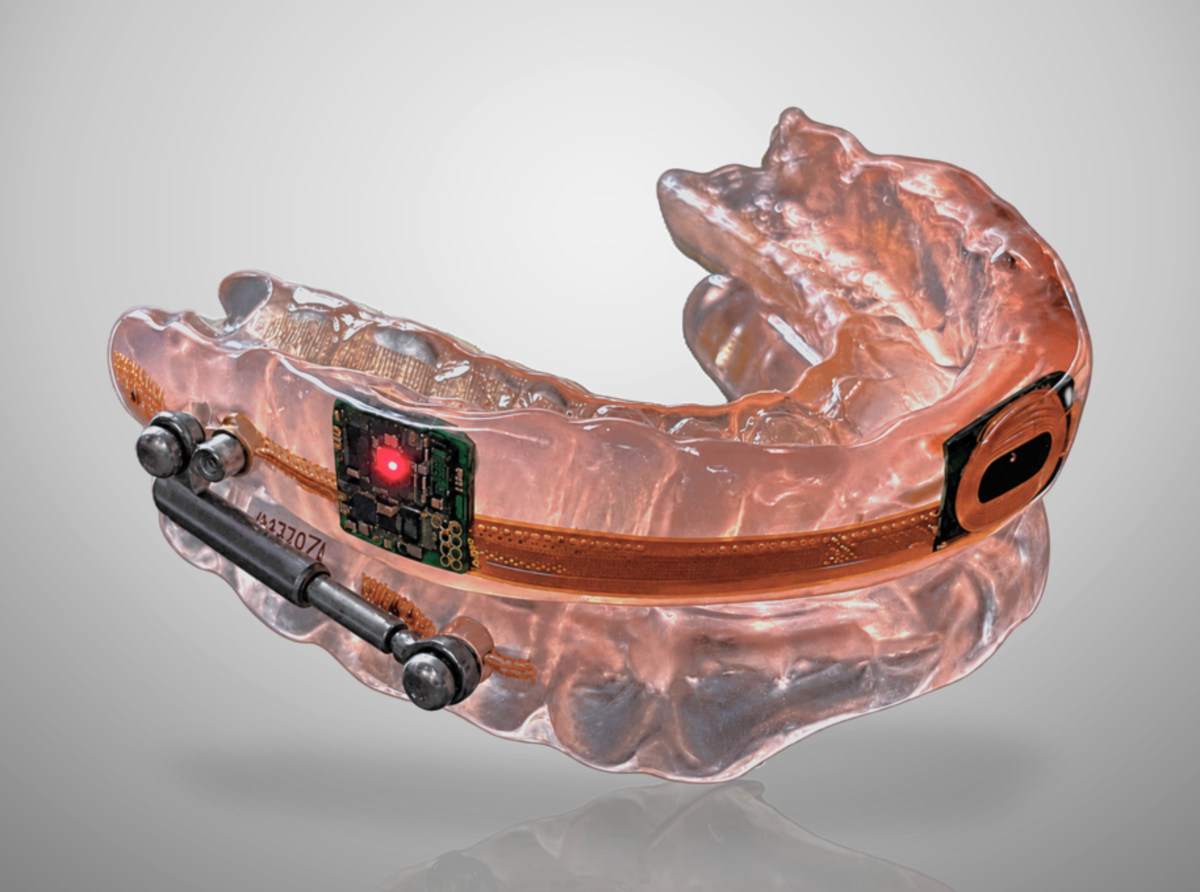
Achaemenid's idea was to put the sensor somewhere patients already tolerate all night: inside a custom oral appliance. The team had tested the concept using off-the-shelf components and proved the opposite of what they hoped. Nothing available was practical to wear through a full night of sleep.
They needed a fully custom device, and a partner who could build the electronics for it.
The Solution
C3 developed the electronics and firmware for the iNOS biosensor from the ground up, built the companion mobile app, and designed the wireless charging system. Achaemenid owned the oral appliance itself, including its housing and encapsulation.
One constraint shaped every decision: size. The sensor had to disappear inside an appliance worn in the mouth, while collecting more data than devices many times its size.
The electronics had to flex. Literally. The board bends around the jaw line, because no two patients' appliances are the same shape.
Nothing could break the surface. A device worn in the mouth overnight is completely encapsulated. No electrical contacts, no wires, no buttons, no charging pins, no USB port. That rules out every conventional way of getting power in or data out. Power arrives through a wireless charging cradle the patient uses during the day, so the device is ready for the night and lasts the full sleep cycle. Data leaves over Bluetooth Low Energy.
Power management decided what was possible. The device runs continuously through a night on a single charge while capturing SpO2, heart rate and 6-axis motion, a heavier data load than a consumer wearable such as a smart ring carries, from a far smaller package.
No lost data. Bluetooth connections drop. A patient gets up in the night and walks out of range of the phone. C3 built on-board memory buffering so the record continues through the gap and nothing is lost when the connection returns.
The app was the hard part. A full night of continuous data has to leave the device without losing any of it, while the volume fights the encryption and both fight the power budget. C3 built the companion app that carries all three at once, and clinicians use it to view and track patient data in real time.
The documentation came with it. C3 completed the verification and validation testing and produced the engineering documentation for the FDA submission, along with a cybersecurity assessment and penetration testing. That is standard on C3 projects: we create the engineering documentation the FDA needs.
The Results
The iNOS intraoral biosensor received FDA 510(k) clearance in September 2026 under K254304.
What began as a defined project became an ongoing partnership. C3 is now supporting Achaemenid through production ramp-up toward high-volume manufacturing in the 10,000 to 25,000 unit range, which has meant developing manufacturing test code, test equipment and programming fixtures.
Soft launch is planned for October 2026, with full commercial availability expected in Q1 2027.
The iNOS biosensor and the RADx White Night appliance are both on Achaemenid's product page.
Project gallery